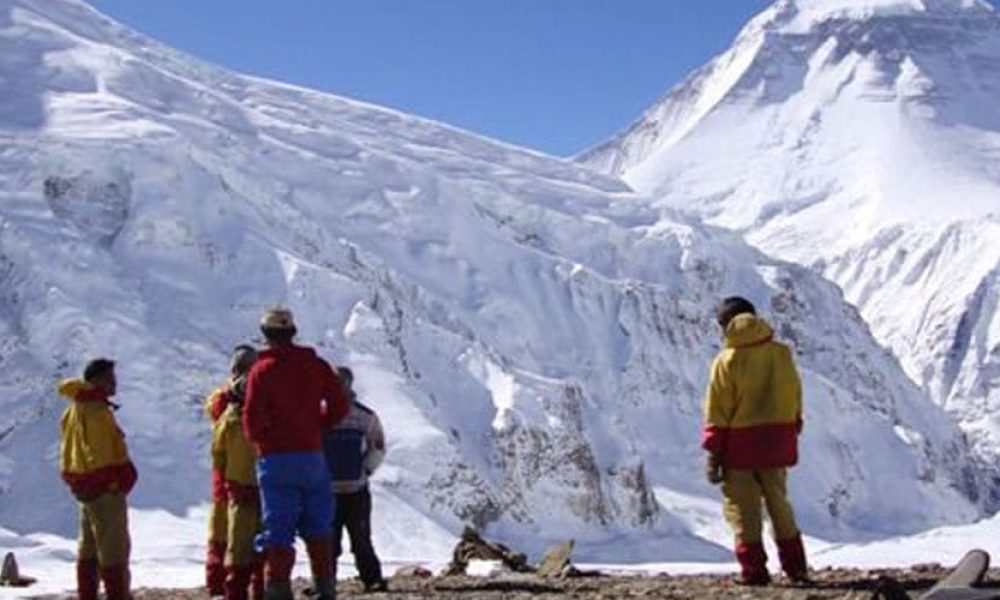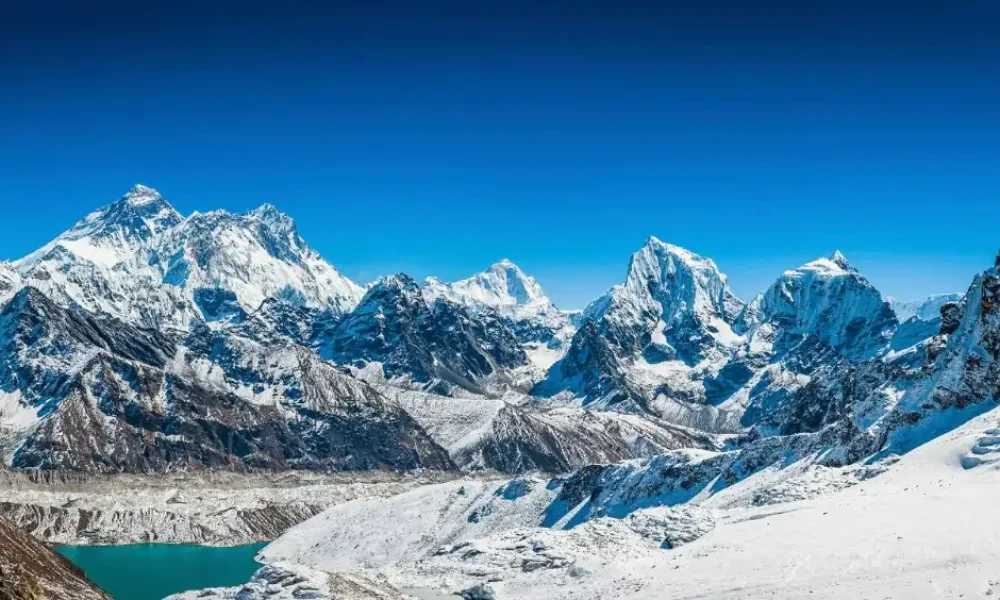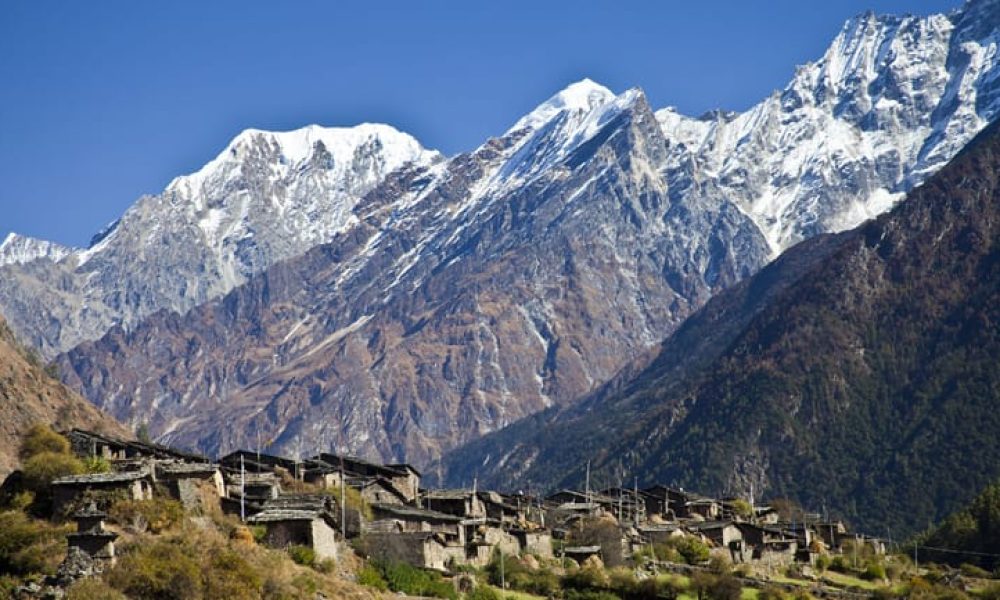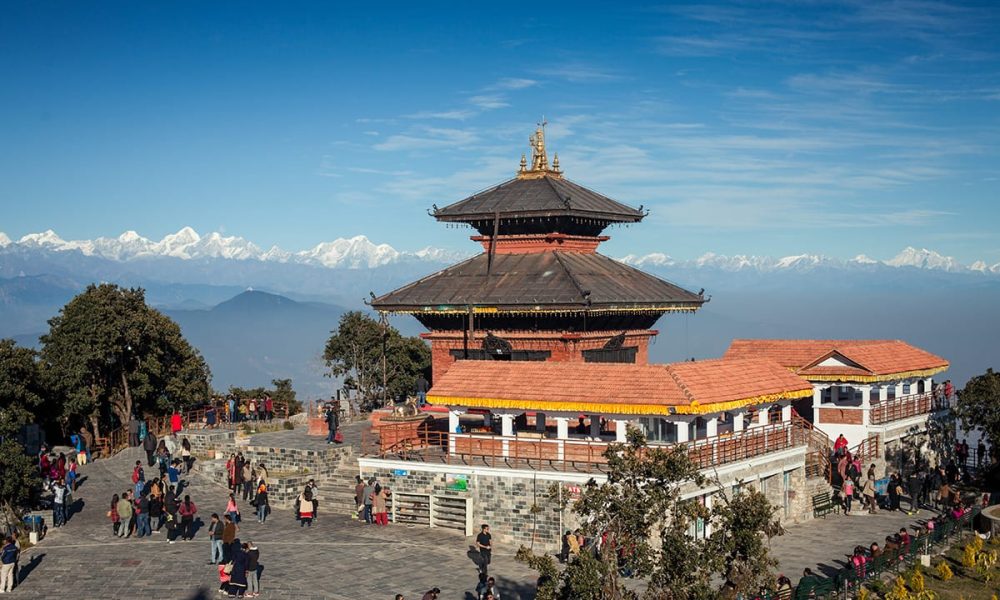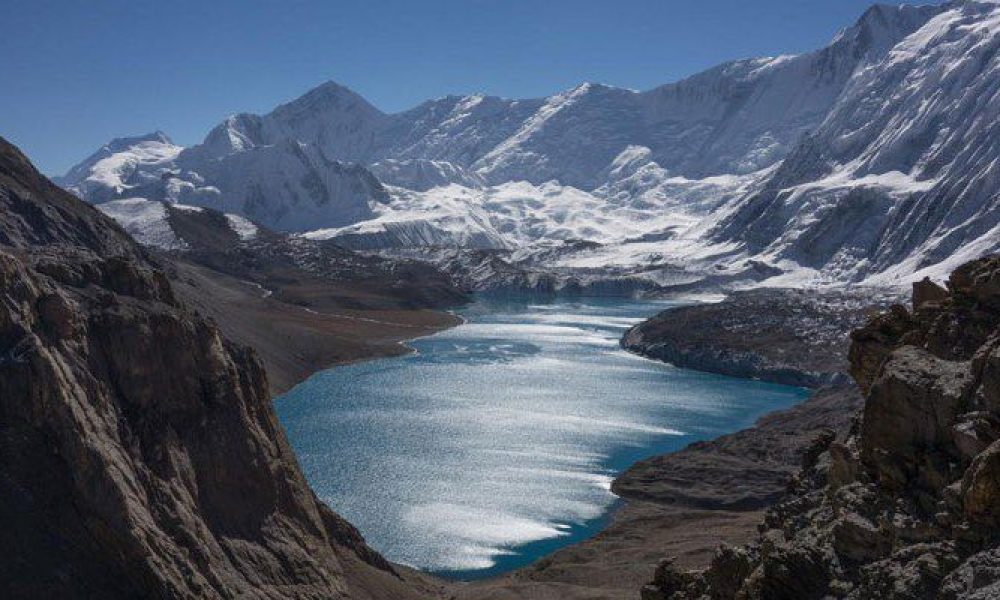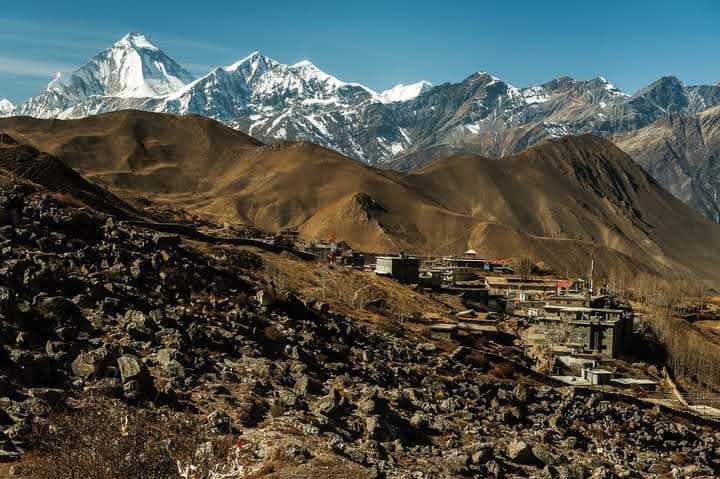
Upper Dolpo Trek is one of the most adventurous and culturally rich trekking experiences in Nepal. Located in the remote northwestern part of Nepal, Upper Dolpo is a hidden gem that offers trekkers a unique combination of natural beauty, ancient Tibetan culture, and pristine wilderness. Here is a detailed description of what to expect from an Upper Dolpo Trek.
The Upper Dolpo Trek encompasses the northern part of Dolpo, usually called Inner Dolpo. This region has long had an aura of mysticism about it. The goal of most trekkers in the inner Dolpo is Shey Gompa, largely because of the metaphysical discussion of the region in Peter Matthiessen’s book, “The Snow Leopard.”
Shey Phoskundo was closed to foreigners until 1992. One story cites the reason for closure as the large–scale theft of statues from monasteries. Despite the mysticism surrounding Shey and the “Crystal Mountain,” this is not a popular trek by any means. The harsh terrain, the tough physical challenge, and high fees have deterred most people.
On the first day, our airport representative will welcome you at the Airport Terminal, and then you will be taken to the Explore Nepal Trails office at Swayamhbu. At our office expert will provide you with further detailed information about the trip, and all the terms and conditions will be disclosed. Our representative safely and comfortably takes you to the respective hotel. You can enjoy the city’s nightlife in the main tourist hub of Kathmandu: Thamel.
This day is scheduled to visit the UNESCO-listed World Heritage sites, including Swayambhunath, Patan Durbar Square, Bouddhanath, Pashupatinath, along with other historical and holy places.
From Kathmandu, we take an early morning flight to Nepalgunj, one of the huge business hubs and industrial areas of Nepal. After half an hour of flight, we landed at Nepalgunj airport and were transferred to the 2-star hotel for check-in. The remaining day in Nepalgunj is for visiting some interesting places and giving the limbs and muscles a rest.
After an early morning breakfast, we drive to Nepalgunj airport and take a flight to the Dolpo region. After 25-35 minutes of scenic mountain flight, the plane landed at Juphal airport: the only airport of the Dolpo region.
From Juphal, we follow the terraced farmland along the Bheri River and walk through the narrow gorge for a few hours until the trail comes to the administrative headquarters of Dolpa: Dunai. In the evening, we explore the headquarters and spend a good time with the fellow trekkers. Tonight, we stay at Dunai.
From Dunai, we begin our trek after having a delightful breakfast. At first, we walk along the Bheri River, then cross suspension bridges, a deep gorge, and trace through the terraced green fields to reach the village standing on a hillock: Tarakot.
The village was once a small headquarters of the independent Tichorung Kingdom. The village is famous for the town fortress, which was built in ancient times. Explore the entire village if we have plenty of time remaining before taking shelter inside the camp.
We start today’s journey after a delicate breakfast at Tarakot. From this village, we cross the river and climb through the buckwheat field, enjoying the pristine view of Putha Himal and Churen Himal. The trail crosses several rivers and leads us to Kanigaon, from where we ascend to Sandul Gompa, situated at the junction of the Barbung Khola and Tarap Chu River.
The trail now traces through the dense trees and narrow gorge along the river and finally reaches the beautiful village of Laini. The village is the best camping site at the foot of the small surging waterfall nearby.
Enjoying the splendid view of the surging waterfall, we have our delicate breakfast at Laini. The trail today traces from Laini, climbing the mini pass and steep gorge before we descend to the cascade of Tilba Khola. From here, we climb up another ridge, then descend to Chyugur Khola and cross the suspension bridges to trace to Nawarpani.
Today’s trail is comparatively one of the variable trails of the trek. After early morning breakfast, we trace through the narrow gorge, then after crossing a bridge, and climb steeply up to the cliff from where the trail descends down to the Tarap Chu River.
To move further ahead, we cross a wooden bridge over Tarap Chu and ascend to a ridge at Serkam, which was once a border between Nepal and Tibet. The trail from Serkam descends to Sishul Khola and climbs to the top of the ridge from where we finally drop down to the flat valley where we set camp for today’s shelter.
Today’s first hour walk leads along the level path through a glacial valley that now heads north. At the confluence of the Phoksundo Khola and another mountain stream, there is an old wooden bridge. Here, taking the barely distinct path to the north-east of the valley.
There is no trail as such, so it is necessary to clamber over the rocks and boulders and to ford a stream that rushes down the steep valley. A long climb brings us to a sheep meadow where the trail veers up a steep ravine. A hard climb to the top brings one to yet another valley where one can see the Kang-La, the pass which will lead towards Shey Gompa.
Morning walk leads up to a steep climb littered with slate towards the pass. The climb is quite strenuous, especially on the slate screed. From the top of Kang-la 5,160m/16925ft, there are excellent views down upon a large valley which is bisected by a gushing river. On descending steeply to the valley floor, the path leads a long, meandering trek along the banks of the river, crossing and re-crossing it several times.
There are mud caves lining the hills overlooking the river, and we pass through meadows where hairy yaks, hundreds of sheep, and domestic mountain goat (Chengra) can be found grazing as well, near the odd nomadic hut of the herders. A red chorten heralds our arrival at Shey Gompa, 4,390m/14,440ft, where a quaint wooden log bridge leads up to our destination at the Shey Gompa compound for our overnight camp.
Another well-earned rest day for a local hike around Shey, meaning crystal, this monastery is also known as the Crystal Mountain (well described in Peter Matthiessen’s classic novel Snow Leopard). The lama of Shey resides at a red hermitage known as Tsakang gompa, which is north of Shey. It is rather a retreat than a monastery. Tsakang had been a meditation centre of many famous lamas from Tibet.
Shey Gompa belongs to the Chaiba community, followers of great saint Padmasambhava, known as Guru Ringpoche, and the Kagyu sects. It was the first Kagyupa monastery, and its founder was the lama Tenzing Ra-Pa, built during the 11th century. Shey is famous for its ancient pre-Buddhist culture, the Bon Po. In Dolpo, the ancient Tibetan way of life combines animism with the teachings of Buddha. Drutup Yeshe first introduced Buddhism in the Dolpo valley. Hundreds of years ago, he came to Dolpo, encountering a wild people whose supreme God was a ‘fierce mountain and nature spirit.
Crystal Mountain is to the east of Shey gompa. It is one of the strangest mountains, as its contorted cliffs are laced with quartz and embedded with a rich variety of marine fossils. Shey Gompa stands above the confluence of Kangjunala and Yeju Nala River.
Near the confluence, there is a group of prayer mills turned by water wheels. Each year, people from all over the Dolpo region travel great distances to attend the festival at Shey and to complete the circuit of Crystal Mountain. This is an amazing trip here that certainly makes this trek as special as only a few Westerners have ever ventured up to Shey gompa.
Our day begins by following a pleasant trail amidst juniper, which descends into a grey, stony canyon. Then the path begins to zigzag over bare rocks and coarse eroded soil until it eventually brings us to the top of Saldang-la, 5,200m/17,056ft.
The subsequent descent towards the north is long and tiring, but we finally come upon the welcome sight of pastures of grazing yaks and sheep, and nomadic tents made from yak hair. This signals our approach to Namgung Gaun at 4,800m/15,744ft.
Like Shey, the Namgung monastery is of the Karma-pa sect. The monastery, a red stone structure, is built against the backdrop of a cliff on the north wall of a gorge. The red and white colors of the gompa and its stupas are the only colors in this stark landscape.
The village itself consists of only six stone houses and has terraced fields on both sides of the tributary, which flow down to the Nam Khong valley. The economy of the region is based on agriculture, animal husbandry, and trading. In Dolpo, only one crop a year can be grown, and this is mainly barley. In some villages, buckwheat, oilseed, potato, and radish are also cultivated.
On leaving the Namduna Gaun, our route leads to a climb up a scree slope. Further on, it begins a long traverse along some dusty, barren mountains. After 3-4 hours of hard climbing, Saldang 3,620m/ 11,874ft appears below on a plateau high above the Nam Khongmala. It has a picturesque appearance.
Saldang is the largest village of the inner Dolpo area. Though the village lies at about the same altitude as Ringmo, it is totally different then Ringmo, a Himalayan village is situated below the tree line, while Saldang belongs to the arid zone of the Trans-Himalayan Tibetan plateau. The village stretches for nearly two kilometers on an open slope. Saldang consists of five villages, having about eighty well-built houses with nearly six hundred people. Saldang is a prosperous village not only agriculturally but also for its strategic location on a trade route to Tibet.
After the Chinese invasion of Tibet in 1959, trade with Tibet was virtually stopped. It has been restored to some extent through the barter system by which Tibetan salt reaches mid-Nepal. The Drokpa people from the western plains of Tibet collect salt from the dried lakes north of the Tsangpo.
Our journey from here diverts further north to the least unexplored area by westerners or by any other commercial adventure trekking companies. The trail follows the Nang Chu River most of the way through this wild, barren, windswept terrain.
The walk begins along the fairly gradual path with few ups and downs slope and then passes through the small settlement of Tiling and Lurigaon till we reach our overnight camp at Yangze, also known as Yangtsher, just before Yangze near Lurigaon.
Here we cross the tributary Panzang river, a short walk from here brings us to an unexplored region of Yangze 4,960m/16,267ft and its very old Bon-Po Monastery for the overnight halt with time for exploration around the villages and the Monastery.
From Yangze, two trails connect Sibu (4,560m/14,957ft), the long way trail heads due west, passing through the very remote villages of Nishalgaon and further past Shimengaon. To save time and energy, we will retrace the path back towards Saldang village, which will be much easier and shorter than the other northwestern route.
From Saldang, the trail following the river bed, we pass through terraced fields, stupas, chortens, heaps of mani stones, and a Chaiba monastery, then passing through the Namdo village, which is also prosperous with about sixty houses having nearly 400 inhabitants. It stretches for more than 5 km on the high slopes to the left of Nam Khong Khola.
The Namdo monastery is located near the riverbed. Our journey continues further down the river for another two hours to camp near the small settlement of Sibu.
Today’s trail follows the Nam Khong Khola for a while on the morning walk, coming across a caravan of laden yaks that are on their way towards the Tibetan border. After days of following the same river, finally we part, turning east till we arrive at the confluence of two small tributaries, from here our walk leads to a steep climb to the bottom of Jeng La (4,900m/16,072ft), where we stay for the night on a nice meadow.
Morning trek leads to an hour climb towards the top of the Jeng La (5,090m/16,695ft). An excellent view of the snow ranges emerges to the south. The north face of the Dhaualgiri massif shines in the morning light. After a wonderful moment here at the pass, our walk leads to descend on the rough path towards the Tarap Valley. By afternoon, we come to the green valley, which leads us on the pleasant track down towards Tarap Chu.
Tarap is a fascinating valley with vast plains in high mountains. It extends twenty kilometers along the river. Tarap Chu has ten villages with their cultivated fields and many gompas, chortens of both sects. Visit the Tokyu monastery at 4,200m/13,776ft. This monastery also belongs to the Chaiba sect. The route leads eastward along the downhill course of Tarap Chu in a plain valley with patches of lush, verdant grass on both sides of the river, which is completely different from other parts of inner Dolpo.
There is also a marsh, which is a common feature in the Desert Mountains of Tibet and the Ladakh Himalaya. In this valley, both Bon Po and Chaiba sects reside together in harmony. After a short trek in this beautiful valley, we come to Do Tarap (4,080m/13,382ft)
The name Tarap refers to the entire region. The correct name of the village is Do, meaning ‘lower end of the valley’ in Tibetan, but most local people refer to the village as Do Tarap. It consists of several clusters of closely packed houses and corrals, surrounded by fields of naked barley.
The Ribo Bhumpa Gompa above the village was rebuilt in 1955; beside it is unique chorten in a unique chorten containing the remains of a demon killed by Guru Rinpoche. The painting inside the chorten represents both Bonpo and Nyingma traditions, although the Gompa itself is Nyingma. The view over the valley is superb. For a leisurely half-day excursion, head east up to the valley to Dero Gompa and Shipchok Gompa, a school of Bonpo.
Today’s walk can be quite a long day or a moderate walk, depending upon the choice of several different campsites, so the itinerary can be as flexible as you like. From the quite bare country around Tarap, we descend towards a wide valley which eventually narrows into a gorge. We walk along the juniper bush and wild rose, typical of dry inner Himalayan valleys, to just above the tree line.
On this route, we might see herds of blue sheep. By the afternoon time we reach the confluence of the Tarap Chu and the Lang Khola, a stream that joins with the Tarap River from further east. We will make our camp on a nice meadow, this place is also known as Karmakharka (3,800m/12,464ft), while our porters will perhaps take shelter in a nearby spacious cave.
This morning again continues down the gorge of the Tarap River, at times alongside it, rising high above on a trail built from the steep slopes, might come across people from Dolpo taking their herds to lower pastures for the winter. There are many possible campsites by the river. This will be one of the exciting days of this trip walk, as the valley becomes so narrow in a deep gorge that in some places we can jump from one side to another.
Sometimes there is no trace of any path, and we have to walk across stone slabs fitted on logs in between the walls, which act as a bridge. The gorge also provides unexpected adventure and thrills. At some places, the bridges are either damaged or washed away, and we may be forced to cross the icy torrent on foot. Finally, reaching the camping spot beside the Tarap Khola at Khanigaon (3,150m/10,332ft)
Today’s trek from the campsite follows an indistinct trail to the village of Lalberi. Then passing through an area of impressive forest, before descending into another gorge, our walk continues following the river again downstream to reach Tarakot, where colourful terraced fields greet us. Tarakot (2,537m/8,321ft) is an old fortress town known by the local people as Dzong, meaning ‘fort’.
Before the Gorkha dynasty, Tarakot was the capital. After lunch, the walk continues beside the Bheri River in a tremendous gorge with pine trees and an ingenious path built about seven meters above the river. On reaching Dunai (2,030m/6,658ft) after completing the circuit with time for celebration, particularly as bottled beers are available in Dunai.
We retrace the journey back to Jhuphal, which is a short distance walk along the Bheri River to the small airstrip for the last overnight camp of this great, memorable adventure.
Early morning, a short scenic flight for thirty-five minutes to Nepalgunj, over the Himalayan foothills, overlooking stunning views of the main peaks, including Annapurna and Dhaulagiri to the north. On arrival at Nepalgunj, depending on the connecting flight schedule to Kathmandu. If it is in the afternoon, have time for a few hours of refreshment in the comfort of the Hotel Batika or similar at Nepalgunj. Then connect with the flight back to Kathmandu.
Transfer to the international airport and fly to the onward destination.
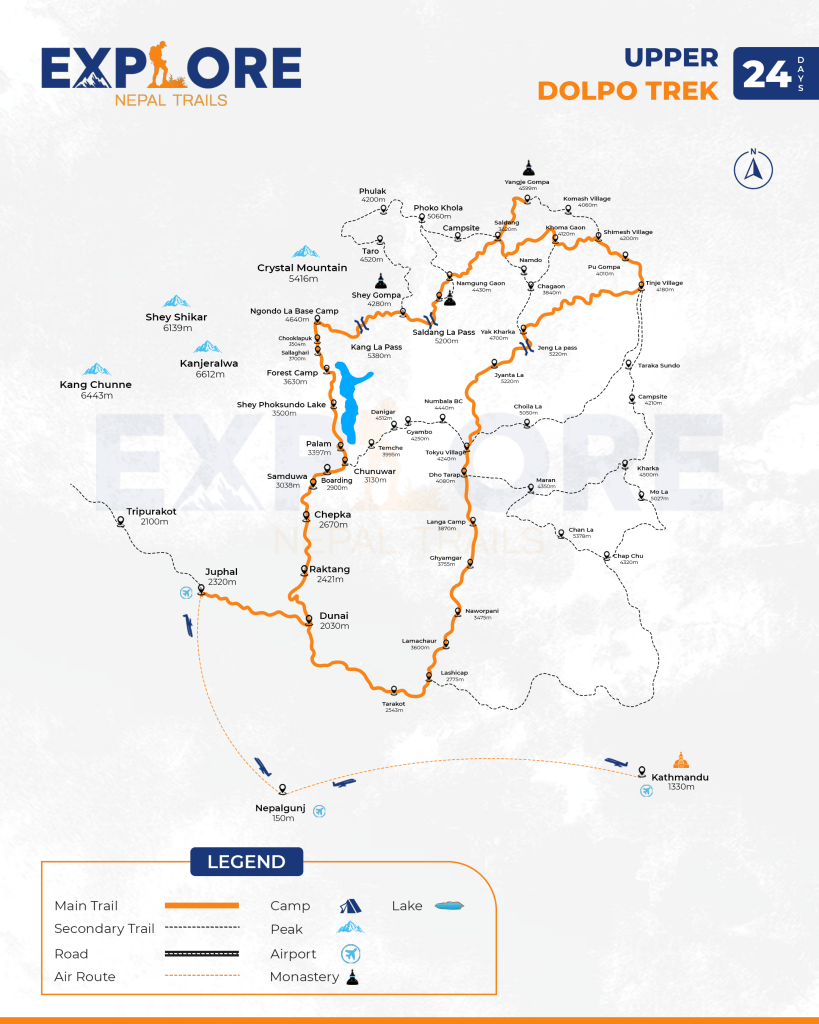
Upper Dolpo Trek is considered strenuous. There are steep ascents, three passes above 5000 m., several nights spent above 3500 m., and some long trekking days of six hours or more.
Dolpa was the location for the 1999 Oscar-nominated film Himalaya and, more recently, for the German documentary Dolpo Tulku. In spite of the near inaccessibility of the region and tourism restrictions for the more remote parts, Dolpa is a popular destination for trekking tourism.
The Upper Dolpo Trek is considered moderately to highly challenging, depending on experience and fitness level. The route crosses multiple high passes above 5,000 m, requires long walking days, and often involves camping in remote regions. However, with proper acclimatization and guidance from experienced trekking crews, it’s a rewarding and safe adventure.
Upper Dolpo Trek is more remote and culturally Tibetan, featuring high passes, traditional villages, and the sacred Shey Gompa.
Lower Dolpo, on the other hand, lies closer to Juphal and Shey Phoksundo Lake, offering slightly easier trails and shorter itineraries. Many trekkers combine both for a full Dolpo Circuit Trek experience.
Since Upper Dolpo is a restricted trekking region in Nepal, trekkers need two main permits:
Restricted Area Permit (RAP): USD 500 per person for the first 10 days, and USD 50 per person per additional day.
Shey Phoksundo National Park Entry Permit: NPR 3,000 (around USD 25).
Permits are issued only through a registered Nepal trekking agency
Accommodation in the Upper Dolpo region is very limited and remote. Most of the trek involves camping, with tented camps, kitchen staff, and porters. Basic teahouses exist only in a few villages, and many nights are spent in wilderness camps.
Because the terrain is so remote and the trek so long, many trekking agencies provide full gear support (sleeping bag, down jacket, camp gear) as part of the package. You should still carry essential personal items (warm layers, boots, sunscreen) and check with your operator about what’s included.
There are no reviews yet. Be the first one to write one.

Explore Nepal Trails is your trusted partner for trekking, peak climbing, and mountaineering adventures in Nepal. From classic Himalayan treks to high-altitude expeditions and cultural journeys, we deliver safe, well-planned, and unforgettable travel experiences.
We Accept

Join our community of over 200,000 global readers who receive emails filled with news, promotions, and other good stuff.

WhatsApp us