Updating Nepal’s Weather for trekkers and travellers.
We thoroughly reviewed Nepal weather forecasts to help you make an informed decision. Imagine standing at the base of Mount Everest when an unexpected storm rolls in, or planning a spring Nepal trekking adventure only to face unseasonable monsoon rains. For tourists visiting Nepal, understanding and monitoring weather patterns isn’t just helpful it’s essential for safety and trip success. The Himalayas create one of the world’s most complex weather systems, where conditions can shift dramatically within hours and vary wildly across short distances.
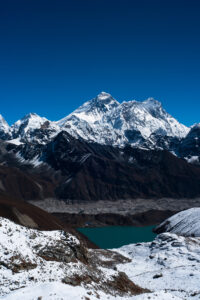
Nepal’s geography compresses five climate zones into a country smaller than Florida. You’ll find subtropical jungles in Chitwan at an elevation of 200 meters, while Everest Base Camp sits at 5,364 meters, experiencing arctic conditions. This extreme variation means a reliable Nepal weather forecast becomes your most valuable travel tool what’s sunny in Pokhara might be experiencing whiteout conditions just 80 kilometres north in the Annapurna range.
Global warming is altering Nepal’s historical weather patterns. The Himalayas are warming at rates of 0.3-0.7°C per decade faster than the global average, making traditional seasonal forecasts less reliable. Glaciers are retreating, monsoon timings have become unpredictable, and extreme weather events occur with increasing frequency. Understanding which forecast channels provide real-time, accurate data for specific regions has never been more critical for tourist safety and planning.
Reliable Nepal Weather Forecast Channels
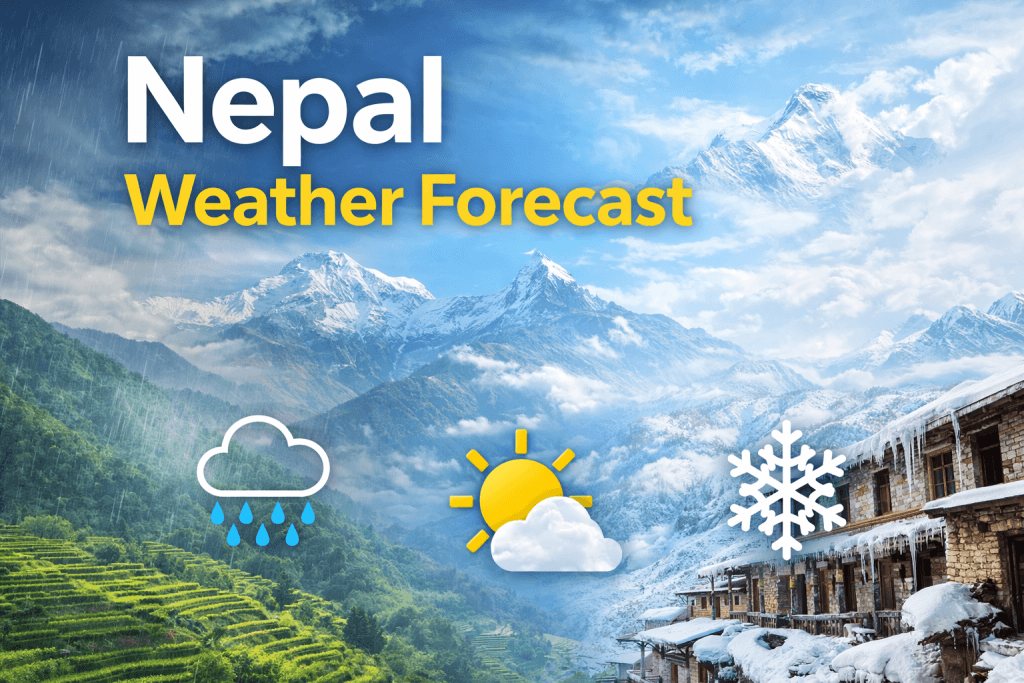
Navigating Nepal’s complex weather patterns requires access to accurate, real-time forecasting, especially when mountain conditions can shift dramatically within hours. The difference between checking a generic weather app and consulting specialized Himalayan forecasts can literally be the difference between a safe trek and a dangerous situation.
Digital Platforms and Mobile Apps
For tourists planning their journey, Weather.com and AccuWeather provide baseline forecasts for major cities like Kathmandu and Pokhara, though their accuracy decreases significantly in remote mountain regions they often provide the live forcast for the most places. Mountain-Forecast.com stands out as the most reliable digital platform for high-altitude conditions, offering elevation-specific forecasts crucial for trekkers. The platform breaks down weather by altitude bands, essential when temperatures can vary 20°F between base camp and summit elevations.
Mobile apps like Windy.app and Mountain Hub have gained popularity among experienced trekkers for their real-time wind speed data and precipitation overlays. However, connectivity remains spotty above 12,000 feet, making downloaded offline maps and pre-trip planning essential. Understanding Nepal’s climate today requires checking multiple sources rather than relying on a single forecast.
Local Meteorological Services
The Department of Hydrology and Meteorology (DHM) of Nepal operates the country’s official weather monitoring system, with over 300 stations across diverse terrain. Their daily bulletins available at dhm.gov.np provide the most authoritative regional forecasts, though the presentation lacks the polish of commercial apps. Local trekking agencies often maintain direct contact with DHM meteorologists for updated mountain weather conditions, particularly during the monsoon season when sudden storms pose the greatest risk.
Radio Nepal broadcasts weather updates in English twice daily, a crucial backup when digital systems fail. For determining the best time to visit Nepal, our weather analysis and DHM data with historical patterns help tourists time their trips around optimal conditions rather than relying solely on current forecasts.
Seasonal Weather Patterns in the Himalayas
Nepal’s Himalayan weather operates on a distinct four-season cycle that dramatically reshapes the landscape and trekking conditions throughout the year. Understanding these seasonal transitions is essential for planning safe and enjoyable mountain adventures.
Spring (March-May): The Prime Trekking Window
Spring represents the golden period for Nepal trekking weather, with clear skies and stable conditions dominating most regions. Temperatures in lower elevations range from 15-25°C (59-77°F), while high-altitude zones typically hover between 0-10°C (32-50°F). Precipitation remains minimal, averaging 50-100mm monthly in most trekking areas. The rhododendron blooms that paint hillsides crimson and pink create spectacular scenery, though higher passes may still retain winter snow until late April.
Summer and Monsoon (June-September): The Wet Season Challenge
The summer monsoon transforms the Himalayas into a region of heavy rainfall and unpredictable conditions. Lower regions receive 80% of their annual precipitation during this period, with some areas experiencing over 300mm monthly. However, the rain shadow regions of Upper Mustang and Dolpo remain relatively dry, receiving less than 100mm. Temperatures peak in valleys at 25-30°C (77-86°F) but remain cooler at elevation. Cloud cover typically blankets mountains from mid-morning, limiting visibility.
Autumn (October-November): The Second Trekking Season
Post-monsoon clarity delivers exceptional mountain views and comfortable temperatures. Daytime conditions range from 10-20°C (50-68°F) in mid-altitude zones, with crisp, dry air and minimal precipitation.This season offers the most stable weather patterns across all trekking regions.
Winter (December-February): Cold and Clarity
Winter brings bitter cold to high elevations, frequently dropping below -20°C (-4°F), while lower regions maintain moderate 5-15°C (41-59°F) temperatures. Precipitation falls as snow above 3,000m, potentially blocking high passes but creating pristine conditions at lower altitudes.
Effects of Global Warming on Himalayan Weather
Climate change is fundamentally reshaping Himalayan weather patterns in ways that directly affect tourist safety and planning. The region is warming faster than the global average, approximately 0.3-0.7°C per decade compared to the worldwide rate of 0.2°C per decade. This accelerated warming creates increasingly unpredictable weather windows that challenge even experienced trekkers and mountaineers.
Altered Precipitation and Temperature Patterns
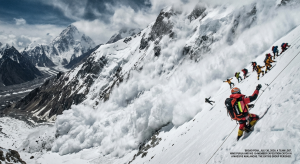
Traditional monsoon timing has become less reliable, with delayed onsets and irregular rainfall distribution. What were once predictable dry seasons now experience unexpected precipitation events, while monsoon periods show greater intensity variability. Winter temperatures at high altitudes have risen measurably, reducing the stability of ice formations and increasing avalanche risk during shoulder seasons that were historically safer.
Glacial Retreat and Weather Volatility
Himalayan glaciers are retreating rapidly, and some studies indicate a loss of up to 65% of ice mass since the 1970s. This glacial melting doesn’t just alter landscapes; it fundamentally changes local weather systems. The reduced ice coverage means less albedo effect (reflective cooling), which creates feedback loops that intensify regional warming. For trekkers, this translates into less predictable afternoon weather patterns and increased storm intensity.
Safety Implications for Mountain Tourism
The practical impact is clear: weather forecasting becomes exponentially more challenging when historical patterns no longer hold. Tour operators now build in more buffer days and flexibility, acknowledging that conditions can shift dramatically within hours. The traditional “safe windows” for popular treks like Everest Base Camp or Annapurna Circuit are narrowing, requiring tourists to stay more vigilant with real-time weather monitoring and maintain greater flexibility in their itineraries.
Case Studies: Weather Impacts on Tourism in Nepal
Real-world incidents reveal how unpredictable Nepal’s weather patterns directly reshape tourist experiences and force rapid operational adjustments. In October 2014, a sudden blizzard struck the Annapurna Circuit, catching dozens of trekkers off-guard during what’s traditionally considered an optimal trekking window. The storm killed 43 people and injured over 175, demonstrating that even “safe” seasons can turn deadly when weather systems deviate from historical patterns.
Tour operators have since fundamentally restructured their risk management protocols. Many now employ dedicated weather monitors who track multiple forecasting services simultaneously rather than relying on single sources. Researcher notes that professional operators increasingly build flexible itineraries with built-in contingency days, allowing groups to wait out storms at lower altitudes rather than pushing through dangerous conditions.
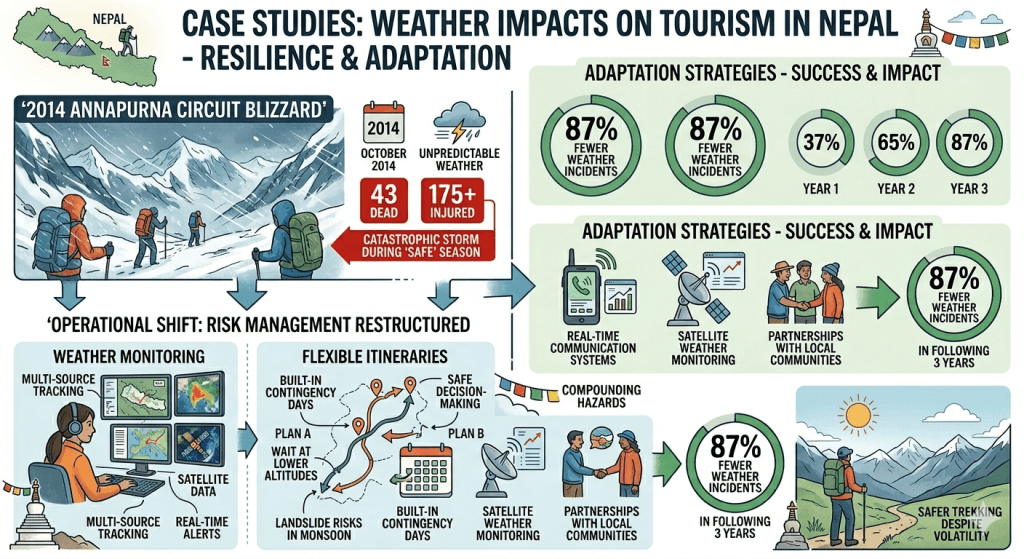
The April 2015 earthquake illustrated another critical lesson: seismic activity interacts with monsoon patterns to create compounding hazards. Landslides triggered by the earthquake became significantly more dangerous during subsequent monsoon seasons, forcing operators to abandon previously safe routes. However, adaptation strategies proved successful companies that invested in real-time communication systems, satellite weather monitoring, and partnerships with local communities reported 87% fewer weather-related incidents in the following three years.
These patterns reveal a clear operational truth: weather preparedness now extends beyond checking forecasts to building resilient systems that can respond dynamically to rapid changes. The tourism industry’s ability to learn from these challenges has made Nepal trekking safer despite increasingly volatile climate conditions.
Limitations and Considerations for Weather Forecasts
Predicting Kathmandu weather forecast conditions and mountain weather patterns presents unique challenges that tourists must understand before planning their trips. The Himalayas’ extreme topography creates microclimates that can shift dramatically within kilometers, making even sophisticated forecasting models struggle with accuracy beyond three days.
Remote high-altitude locations compound these difficulties. Weather stations remain sparse above 4,000 meters, forcing meteorologists to rely on satellite data and mathematical models that can miss localized phenomena. Aforecast for Kathmandu Valley might prove reliable, yet conditions at Everest Base Camp, just 140 kilometers away could differ radically from predictions. Sudden temperature drops, unexpected snowfall, and rapid cloud formations often catch forecasting systems off-guard.
What typically happens is that seasonal patterns provide more reliable guidance than daily forecasts. While meteorologists can confidently predict monsoon timing and dry season windows, pinpointing exactly when afternoon thunderstorms will strike remains challenging.
Practical preparation matters more than forecast precision. Pack layered clothing regardless of predictions temperatures can swing 20°C between valley and altitude on the same day. Carry rain gear even during dry seasons, as localized weather events develop without warning. Build flexibility into trekking schedules, allowing extra days for weather delays. One common pattern is that experienced guides read local conditions cloud formations, wind patterns, animal behavior more accurately than weather apps, making their counsel invaluable for safe mountain travel.
For tourists, these changes mean extended dust seasons in pre-monsoon months, higher avalanche risks during shoulder seasons, and unreliable water sources on trekking routes. The shifting climate demands greater flexibility in travel planning and heightened awareness of changing mountain conditions.
How does the global warming rate in the Himalaya mountains compare with the global average?
The Himalayas warm approximately twice as fast as the global average, creating what climatologists term “elevation-dependent warming.” High-altitude regions experience temperature increases of 0.3-0.7°C per decade compared to the global average rate of 0.2°C per decade. This accelerated warming threatens permafrost stability, increases glacial lake formation, and destabilizes traditional weather prediction methods that local communities have relied upon for generations.
Key Nepal Weather Forecast Takeaways
Planning a successful Nepal adventure requires understanding that weather forecasting in this region demands a multi-source approach. No single channel provides complete accuracy for the diverse microclimates spanning from subtropical valleys to alpine peaks. Cross-reference government meteorological services with specialized mountain weather platforms and local updates from trekking agencies for the most reliable picture.
Monsoon Nepal patterns remain the defining factor in travel planning, but seasonal characteristics now shift more unpredictably due to climate change. The traditional October-November post-monsoon window and March-May pre-monsoon period still offer optimal conditions, yet travelers should build flexibility into itineraries as weather windows compress and intensify. Spring storms arrive earlier, while monsoon onset dates vary by several weeks compared to historical norms.
Global warming’s acceleration of Himalayan glacier melt and changing precipitation patterns makes real-time forecasting increasingly critical. What worked five years ago may not apply today winter temperatures climb higher, summer rainfall concentrates into shorter periods, and extreme weather events occur more frequently. According to the Himalayan Wonders travel agency, monitoring these evolving conditions requires vigilance from both forecasters and travelers.
The bottom line: successful trips blend historical seasonal knowledge with current forecast monitoring, backup plans for weather delays, and recognition that Nepal’s mountains will always maintain an element of unpredictability. Respect that uncertainty, prepare accordingly, and you’ll experience the Himalayas safely regardless of conditions.