Mountain Trekking Training takes more than a few gym sessions. Mountain trekking training means building the specific kind of fitness that gets you through six to eight hours of walking a day, for days in a row, at altitude, with a loaded pack. It’s something a normal cardio or strength routine doesn’t prepare you for.
Whether you’re training for trekking in Nepal for the first time or returning for a bigger route, a structured plan in the months before you fly makes the difference between struggling through your trek and actually enjoying it.
This guide walks through a 12-week trekking training plan you can follow whether you live near mountains or not, plus the strength work, load-carrying practice, and altitude-specific preparation that actually matters on the trail.
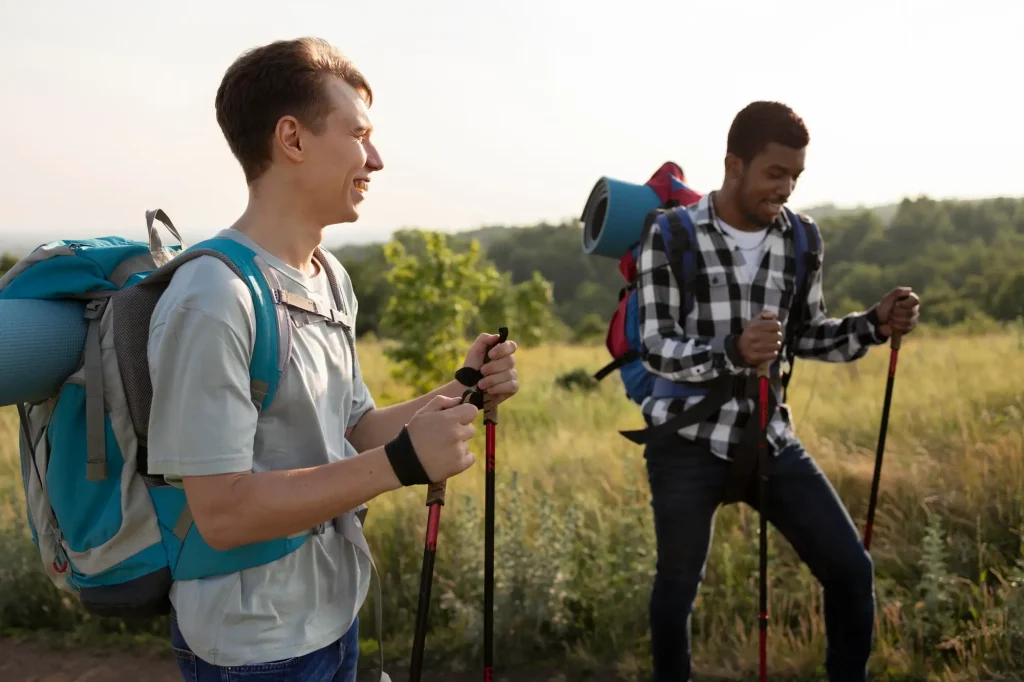
How to Train for High-Altitude Trekking
Training for trekking in Nepal at high altitude is not really about training your lungs to handle thin air. No amount of training at sea level changes how your body responds to altitude itself. What training does is build the underlying fitness that makes acclimatization easier and reduces how hard the trek feels at any given altitude. That comes down to four things:
- Cardiovascular endurance: The ability to sustain a moderate effort for hours, not minutes
- Muscular endurance: Legs, glutes, and core that can hold up over multi-hour days without breaking down
- Load tolerance: Carrying a daypack (usually 5–10 kg) for extended periods without excess fatigue
- Downhill resilience: Descending steep, uneven terrain for hours without destroying your knees
If you only train one of these cardio, say, without any strength or downhill practice, you’ll likely find the trek far harder than expected, even if you’re “fit” by gym standards.

The 12-Week Mountain Trekking Training Plan
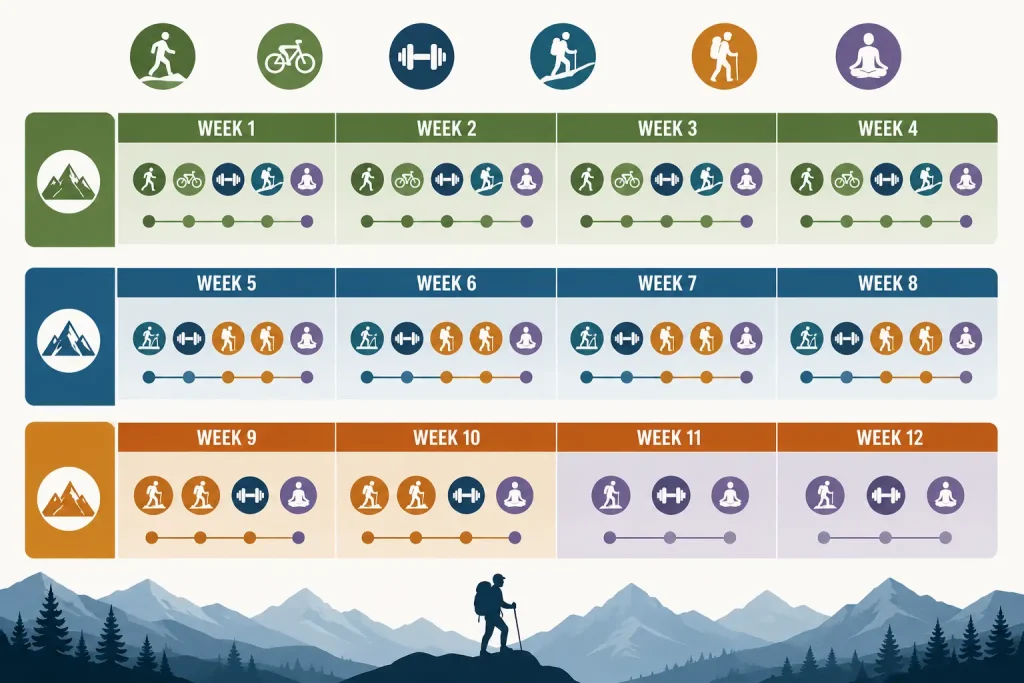
This trekking training plan is structured into three four-week phases, each building directly on the fitness developed in the previous phase. The idea is progressive overload, with gradually increasing duration, elevation, and pack weight, so your body has time to adapt without breaking down or causing overuse injuries. Adjust total volume based on your current fitness level, and make sure to keep at least one full rest day every week throughout all three phases, recovery is where the actual adaptation happens, not the training session itself.
Phase 1: Base Building (Weeks 1–4)
The first month is about establishing a consistent aerobic base and reintroducing your body to regular movement, without overloading it before it’s ready. If you’re coming from a mostly sedentary lifestyle, this phase matters more than any other. Rushing it is the most common reason people pick up early injuries.
| Days/Week | Activity | Duration/Intensity |
| 3x cardio | Brisk walking, cycling, or incline treadmill | 30–45 min, moderate effort |
| 2x strength | Bodyweight circuit (see below) | 30 min |
| 1x hike | Local trail or hilly walk, no pack | 60–90 min |
| 1x rest | Full rest or light stretching/yoga | — |
By the end of Phase 1, you should be able to complete a 90-minute hilly walk without significant fatigue the next day. If you’re still struggling with that benchmark, it’s worth extending this phase by one or two weeks before adding load.
Phase 2: Load & Elevation Training (Weeks 5–8)
The middle phase introduces the two elements most people skip entirely: pack weight and real elevation change. This is where your training starts to actually resemble a trekking day, rather than a generic fitness routine.
| Days/Week | Activity | Duration/Intensity |
| 2x cardio | Incline walking or stair climbing | 40–60 min |
| 2x strength | Weighted strength circuit | 35–40 min |
| 2x hike | Hilly terrain with 4–6 kg pack | 90–150 min |
| 1x rest | Full rest | — |
Start with a lighter pack than your eventual trekking weight and add roughly one kilogram every week or two. This gradual loading protects your shoulders, hips, and lower back from the kind of strain that shows up two or three days into a real trek, if the body has never carried weight before.
Phase 3: Trek-Specific Simulation (Weeks 9–12)
The final phase is about simulating the actual demands of consecutive trekking days, then backing off before departure so you arrive rested rather than run down.
| Week | Focus | Key Session |
| 9 | Peak volume | Back-to-back hikes (Sat/Sun), 8–10 kg pack |
| 10 | Peak volume | Longest single hike (4–6 hrs) with full pack |
| 11 | Taper begins | Reduce volume ~30%, maintain intensity |
| 12 | Taper & travel prep | Light activity only, focus on sleep and hydration before departure |
Weeks 9 and 10 are the hardest of the entire plan by design due to back-to-back long hiking days with a loaded pack are the closest simulation of what an actual trekking itinerary demands, and they reveal any gear or fitness gaps while you still have time to fix them. Weeks 11 and 12 matter just as much, even though the training volume drops, tapering allows your muscles to fully recover and your body to arrive at altitude with full energy reserves, rather than accumulated fatigue from a training block that ran right up until departure.
Strength Training for Trekking
Strength work for trekking training plan isn’t about building bulk or chasing heavier lifts. It’s about joint stability and muscular endurance for repetitive, loaded movement sustained over many hours, day after day. A simple twice-weekly circuit covering the following areas is enough for the overwhelming majority of trekkers, and it doesn’t require a gym membership or specialized equipment:
- Legs: Step-ups, walking, reverse lunges, squats, and calf raises build the quad and glute endurance needed for long climbs
- Core: Planks, dead bugs, and standing rotations stabilize your torso under a loaded pack, which reduces fatigue in your lower back over long days
- Ankles and stability: Single-leg balance work and ankle circles matter more than most people expect, given how much of a Himalayan trail is uneven, rocky, or loose underfoot
- Posterior chain: Glute bridges and Romanian deadlifts, done with bodyweight or light dumbbells, are critical for controlling your descent on steep downhill sections
Two to three sets of 12–15 repetitions per exercise, performed twice a week and layered onto the cardio and hiking sessions above, are sufficient for most people preparing for a standard teahouse trek. There’s no need to train like a competitive athlete. Consistency over the full 12 weeks matters far more than the intensity of any single session.

How to Train for Himalayan Trekking Without Mountains Nearby
Most people preparing for Himalayan trekking don’t live anywhere near real elevation, and that’s genuinely fine, you can build almost all of the necessary mountain trekking training plan without ever setting foot on an actual mountain before your trip:
- Stairwells are one of the most effective substitutes for sustained elevation gain. Repeated stair climbs with a weighted pack closely mimic the muscular and cardiovascular demand of a long trail ascent, and most cities have a stairwell, stadium, or parking garage ramp accessible year-round.
- Treadmill incline settings (typically 10–15%) at a brisk walking pace build much of the same muscular endurance as a real trail climb and let you control duration and grade precisely.
- Weighted pack walks on completely flat ground still build genuine load tolerance in your shoulders, hips, and core, even without any hills involved.
- Local parks, overpasses, or even repeated laps of a hilly neighbourhood can substitute for proper trail access in a pinch.
The one thing that’s genuinely difficult to replicate away from real mountain trails is downhill technique on loose, rocky, or uneven terrain. The specific skill of controlling your pace and footing on a long, punishing descent. If you get even one or two opportunities to hike somewhere genuinely hilly before departure, use that time specifically to practice descending rather than climbing, since it’s the part of the trekking training plan mostly everyone accidentally neglects.

Altitude-Specific Preparation
No trekking training plan is well designed to prevent altitude sickness outright. Acute Mountain Sickness (AMS) is a physiological response to reduced oxygen levels, not a fitness deficiency, and even very fit, well-trained trekkers can and do get it.
What trekking training plan does accomplish is reducing your overall physical strain during the trek, which leaves your body with more capacity in reserve to handle the additional stress that altitude places on it. A few points worth understanding before you depart:
- Ascend gradually and respect the acclimatization days already built into your itinerary. Don’t try to “out-fit” the physiological need to acclimatize properly through sheer cardiovascular fitness.
- Some trekkers discuss preventive medication such as Diamox (acetazolamide) with their doctor ahead of departure. This is a personal medical decision made with a physician, not a substitute for proper acclimatization or pacing.
- Recognizing early AMS symptoms like headache, nausea, dizziness, disrupted sleep matters far more on the trail than any training metric you’ve hit beforehand. For a full breakdown of symptoms, severity, and what to do at each stage, see our detailed guide on altitude sickness on the Everest Base Camp Trek.
Nutrition and Recovery During Training
Training for himalayan trekking means little, without the recovery to support it. During the 12-week trekking training plan, prioritize adequate protein intake to support muscle repair, especially on strength training days, and don’t neglect carbohydrates around your longer hikes.
These sessions are genuinely demanding and under-fueling them slows recovery and increases injury risk. Sleep is arguably the most underrated part of any trekking training plan. Most physical adaptation happens during rest, not during the session itself, so consistently poor sleep can undermine an otherwise well-designed plan.
Staying well hydrated and fueling your body properly during training also primes it for the higher fluid demands you’ll face at altitude where, as research on high-altitude nutrition and hydration shows, dehydration sets in easily and is often missed until it’s already affecting performance.
Common Training Mistakes
- Skipping downhill practice: Most injuries and the worst muscle soreness on treks come from descents, not climbs, yet almost no one trains for it specifically.
- Overtraining in the final two weeks: Pushing hard right up until departure means arriving exhausted rather than rested.
- Never train with a loaded pack: Cardio fitness alone doesn’t prepare your shoulders, back, and hips for carrying real weight over many hours.
- Ignoring flexibility and mobility work: Tight hips and calves make both ascents and descents noticeably harder and meaningfully increase injury risk.
- Training only on flat ground: Even a treadmill set to 0% incline doesn’t come close to replicating what a Himalayan trail actually demands of your legs and lungs.
Ready to Put Your Training to the Test?
Once you’re building your fitness, the next step is picking the right trek for your level. Beginners and moderately fit trekkers often start with the Annapurna Base Camp Trek, while those training for a bigger challenge look toward the Everest Base Camp Trek. Not sure which route fits your fitness and timeline? Our Top 10 Best Treks in Nepal guide breaks down difficulty, duration, and season for every major route.